 English
 Français

Languages
Overview
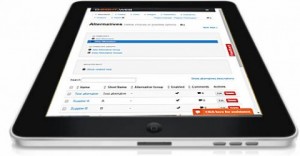 D-Sight's solutions are used by companies and organizations in optimizing project portfolios, in selecting suppliers and generally in any case where group decisions have to be made by comparing different alternatives. The DNA of these applications is our unique, university-developed multi-criteria decision analysis (MCDA) methodology. This method has been used and validated by over 50 universitiesall over the world, which testifies to the scientific reliability of the methodology.
We combine this powerful mathematical algorithm with a state-of-the-art user interface. We pride ourselves in the user friendliness of the system based on a sophisticated method.
D-Sight is an MCDA software that allows you to enrich your raw data and score alternatives before performing any decision analysis. This is done using preference modeling. D-Sight offers two possible methods to do this: PROMETHEE and Utility Functions . Continue reading below for more information on these methods.


Our Methodology
D-Sight’s software solutions are multi-criteria decision analysis (MCDA) tools. MCDA is a sub-discipline of operations research that allows to find the best alternative taking into account multiple conflicting criteria. These problems typically do not have one unique solution, so rather than pointing out a "right" solution, our system helps decision makers find the alternative that suits their goal best and increase their understanding of the problem. Since there is no unique solution, the preferences of the decision-maker have to be taken into account. In D-Sight, you will be able to use either the PROMETHEE or the Utility-base (Multi-Attributes Utility Theory) method to define preferences. Our experts can help you to determine the best way to model your exercise in D-Sight’s software.
PROMETHEE
The PROMETHEE method was developed at the Service de Mathématique de Gestion of the Université Libre de Belgique. It is a pairwise comparisons method, also known as an outranking method. This means that scores of the alternatives are calculated per criterion based on the difference between alternatives.
Choose this underlying methodology if you want the scoring of the alternatives to depend on the performance of other alternatives.
Utility Functions
A Utility Function is a function that relates every value of a criterion to a corresponding score. This means that scores are set independently of other alternatives.
Utility Functions are entirely defined by the user, your function could thus have any shape that corresponds to your preferences (linear, stairs, hyperbolic, etc.)
See Our System in Action
Our system engineers and UI specialists have designed the easiest yet efficient system to collect and analyze data to support the decision-making process. Take your 14 days trial now
What Our Customers Say About Us
"With the increase for water demand and scarcity, utilities require effective strategies for optimum use of available water resources. Deciding on which option to choose amongst conflicting multiple criteria and different interests of stakeholders is a challenging task. The D-Sight Software was key in prioritizing water loss reduction options for Kampala city and made our strategic plan a success."
 Harrison Mutikanga / UNESCO-IHE
"By using D-Sight's advanced methodology, the global process of choice was improved and became more efficient. We also reduced the time spent for comparing and ranking the alternatives. Using a repeatable process allows us to obtain more solid and rigorous results as well as to increase the clients and stakeholders' satisfaction, especially regarding the motivation and thought-process for the choice."
Technical Direction Italferr
"The European Project Ticket to Kyoto has the objective of reducing CO2 emissions in public transport. In that context, we had to select the best technology to recover braking energy in our network. D-Sight decision-making software solutions helped us decrease the complexity of the problem, while assessing the strengths and weaknesses of all different technologies available. It made the whole process more efficient and easy to analyze."
 François-Olivier Devaux / Technical Coordination and Management - Ticket to Kyoto Project